
New, Living Hope
A sermon on John 20:19-31 and 1 Peter 1:3-9
Preached at Ballston Spa UMC on Sunday, April 13, 2026
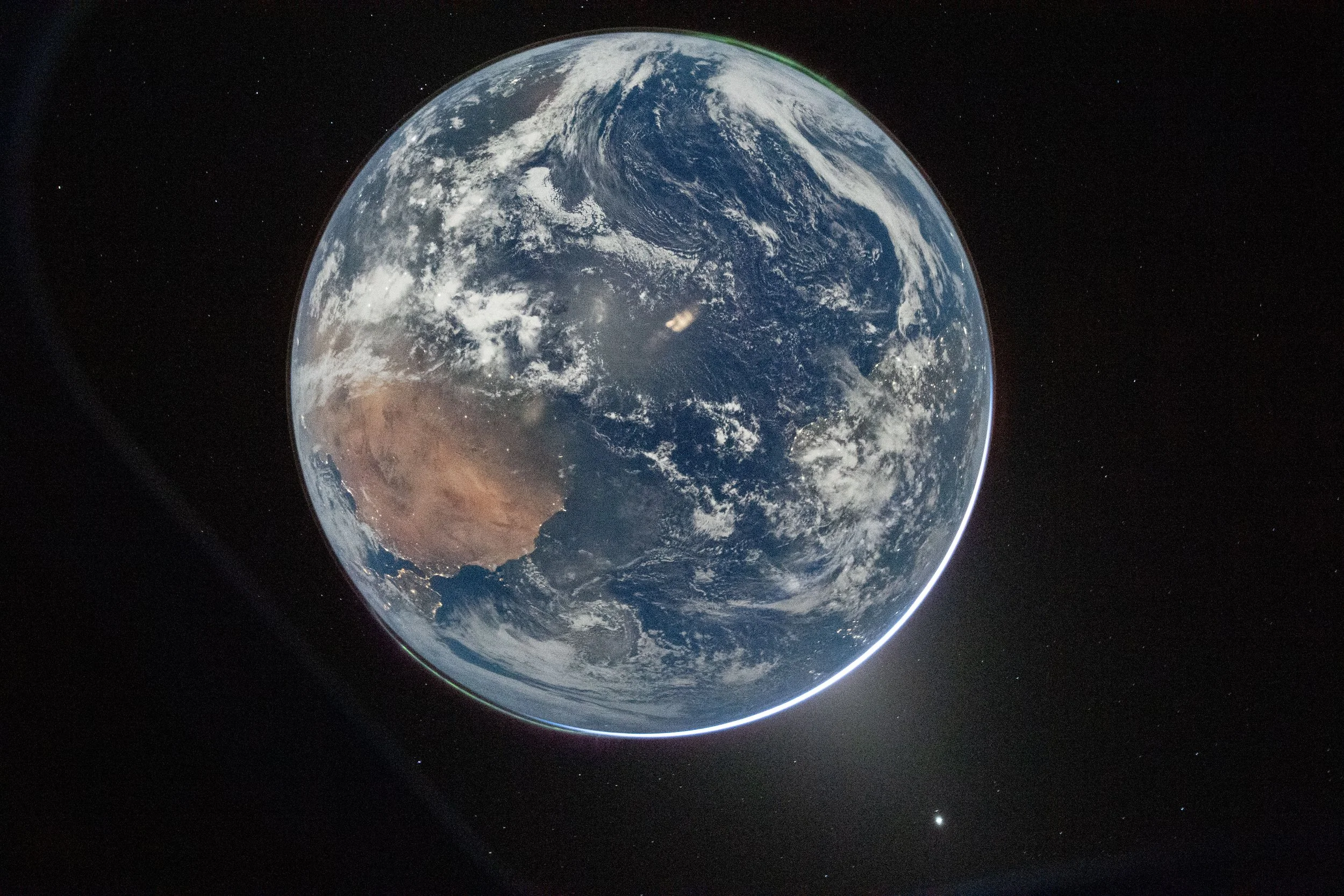
NASA astronaut and Artemis II Commander Reid Wiseman took this picture of Earth from the Orion spacecraft's window on April 2, 2026, after completing the translunar injection burn. Image Credit: NASA/Reid Wiseman
God of all hopefulness and God of all joy, thank you for bringing us together in this time and this place, in your church in this Easter season. By your Spirit, make your presence known among us here today, and may the words of my mouth and the meditations of all our hearts be acceptable to you, our Rock and our Redeemer. Amen.
I have always known what the Earth looks like from space.
I know it’s a weird thing to say, but I don’t mean it in any mystical way. I mean that I have always lived in a world after the Apollo missions. I have always lived in a world with the photos they took of our planet, the photos satellites and other missions have taken since. I have always known that I lived on a blue marble suspended in the emptiness of space and I have always known that people could travel to the Moon.
But some of you haven’t. Some of you were born before the first full-disk images of Earth were taken by astronauts in 1968. Even though you were young, this was still a revelation in your lifetime: before, we had glimpses, peeks at the ground from the air. Now, we can see it fully. We know. And that’s knowledge that we’ve gained just in your time on the Earth.
I’ve been following the nine-day mission of the Artemis II crew, who safely splashed back down to Earth after their trip to the Moon this past Friday.
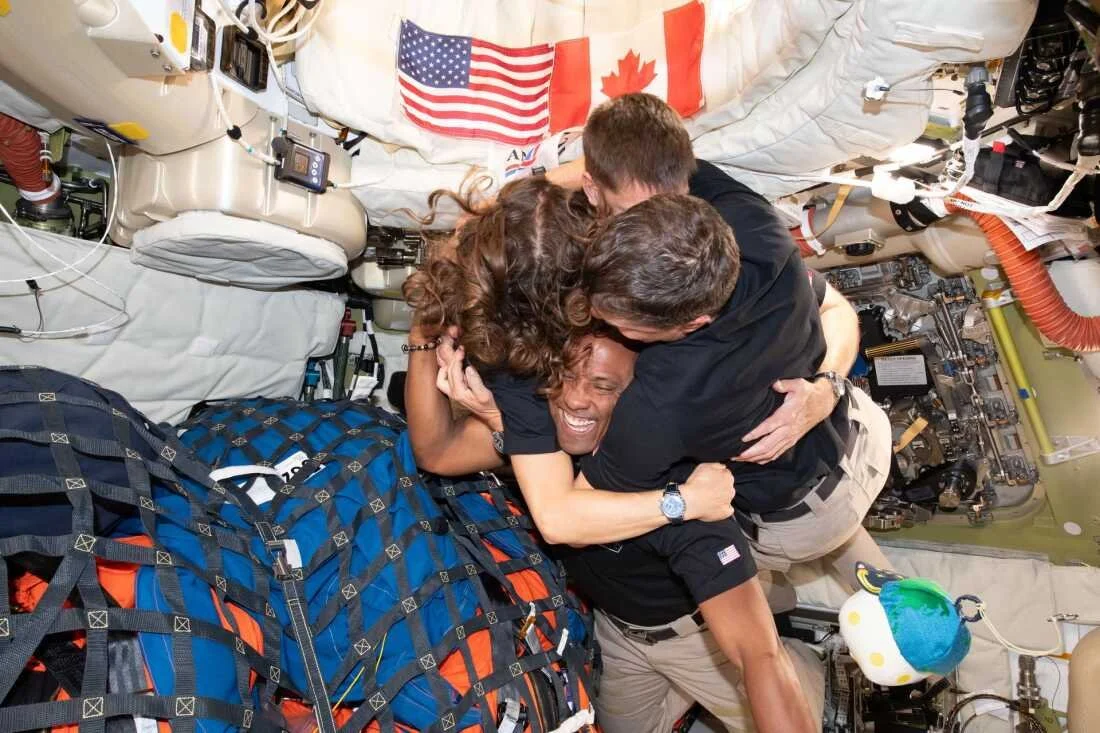
he Artemis II crew – (clockwise from left) Mission Specialist Christina Koch, Mission Specialist Jeremy Hansen, Commander Reid Wiseman, and Pilot Victor Glover – take time out for a group hug inside the Orion spacecraft on their way home. Following a swing around the far side of the Moon on April 6, 2026, the crew exited the lunar sphere of influence (the point at which the Moon's gravity has a stronger pull on Orion than the Earth's) on April 7, and are headed back to Earth for a splashdown in the Pacific Ocean on April 10. The crew was selected in April 2023, and have been training together for their mission for the past three years. Image Credit: NASA
Four astronauts, Commander Reid Wiseman, Pilot Victor Glover, and Mission Specialists Christina Koch and Jeremy Hansen. They launched into space on April 1st (I know, I know, someone really should have told NASA about April Fool’s Day), onboard the new Orion spacecraft system. They flew around the Moon and came back, essentially a crewed test flight of the new Space Launch System, and in the process set a record for the farthest distance from Earth any human has traveled. And y’all know me. I’m a space nerd. This is all very cool. But I think it’s more than that, too.
There’s this phenomenon that’s been observed when people go to space. It’s called the overview effect. Essentially, what happens is that astronauts, when they see the Earth from space, have this experience of awe and self-transcendence. They see the beauty of our home and they have this incredible emotional experience, often causing them to feel a profound sense of connection to other people, to the entire Earth and everyone on it. It doesn’t happen to everyone, but those who experience it are changed forever.
I can’t attest to whether or not the Artemis II crew has experienced the overview effect on their mission, but the way they talk makes me think that they’ve felt it, or something similar, at some point in their life. My thoughts have been captured by something Christina Koch said on this mission. She said, “When we burned this burn towards the Moon, I said that we do not leave Earth, but we choose it. And that is true. We will explore. We will build. We will build ships. We will visit again. We will construct science outposts. We will drive rovers. We will do radio astronomy. We will found companies. We will bolster industry. We will inspire. But ultimately, we will always choose Earth. We will always choose each other.”
Now, I am not a naturally hopeful person. Belief and trust don’t come easy to me. It’s a funny thing for a preacher to say, but it’s true. I have struggled for my faith and I have been known, in tough and in easy times, to struggle with it again. But these words, these words give me something to believe in. “Ultimately, we will always choose Earth. We will always choose each other.”
Our passage from John’s gospel gives us something to believe in too. It’s a dense passage, something that needs more than one sermon to unpack. Jesus breathes the Holy Spirit out on his disciples, giving us a preview of what will come on Pentecost. Jesus tells them that what they bind on Earth shall be bound and what they loose shall be loose. That’s incredible responsibility given to the church, incredible power to heal and incredible power to harm. And we see the need for this work, the work of binding and loosing, when we look to our scientific and engineering feats. Because the same technology that sent the Artemis team into space, the same insights that enable us to see our beautiful planet from space also enable us to do this:
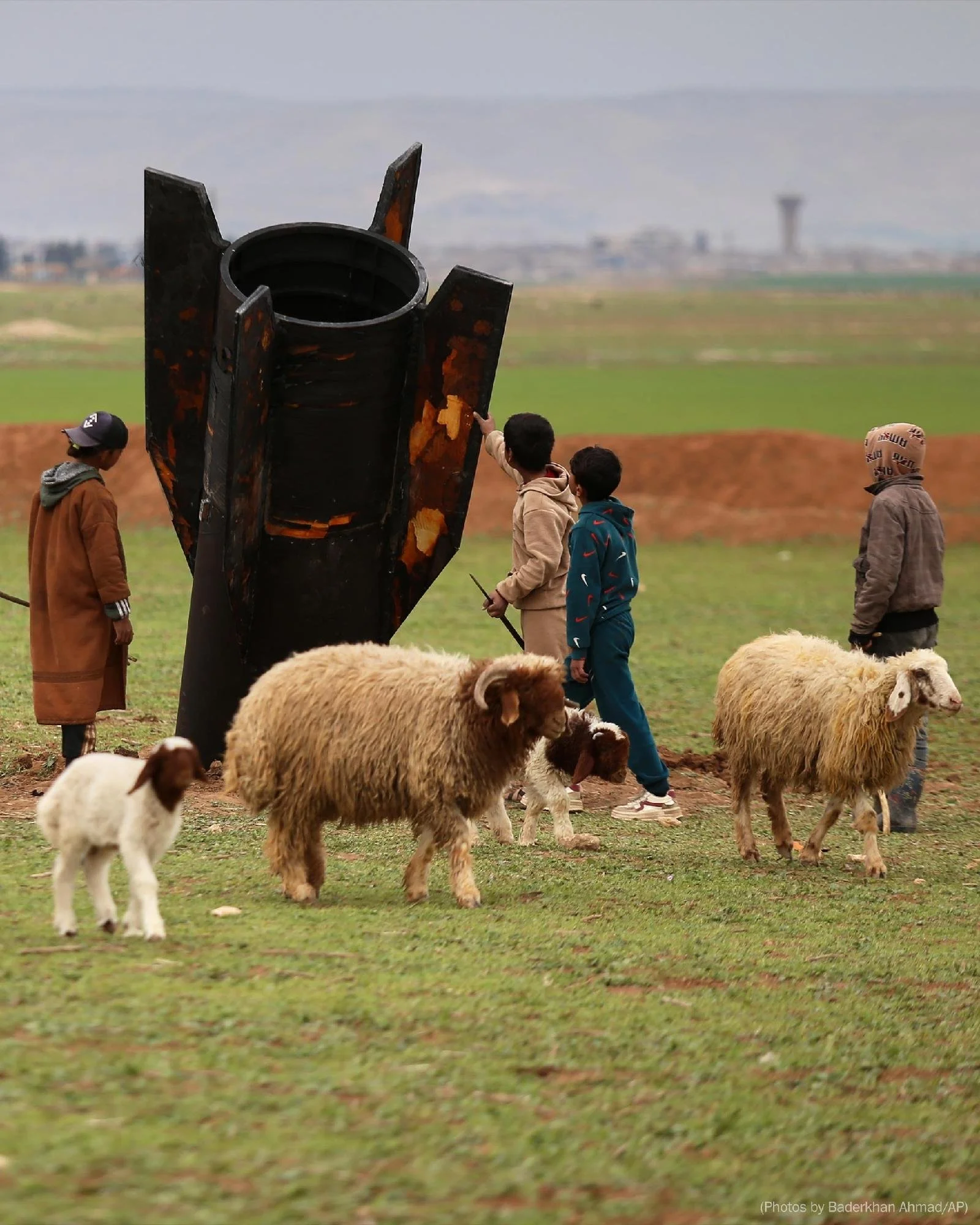
Now, everyone in this picture is okay, thank God. This is an unexploded Iranian missile near Qamishli International Airport in eastern Syria. It was launched on March 5th of this year as a part of our country’s conflict with Iran. Villagers from Dimhiyye al-Kabira came out to see it. And like them, the first time I saw this missile, I couldn’t look away. I had the same feeling I had when I worked at the Smithsonian National Air and Space Museum in DC, looking at the rockets there, built for war, repurposed for space exploration. What incredible potential. And we, Church, if we believe in our sacred stories, we have been given the power to sway how we use this potential. We can bind war, or we can let it loose. I have lived thirty-seven years on this Earth, and for all but nine of them, the wars of my country have been loose.
And this is unbelievable. I know it. It’s theologically too big of a question. That’s why, I think, we pivot so quickly to the story of Thomas. Thomas is out in the world, out risking his life to get supplies or information, when Jesus appears to the rest of the disciples. And even though these are his trusted friends, he doesn’t believe them. He thinks they’ve all lost touch with reality. “Until I put my finger in the nail marks in his hands and my hand in his side, I will not believe.”
Now, as we’ve talked about before when reading John’s gospel, Jesus can come across as a bit of a know-it-all, a bit of a reply guy. Jesus is kinda harsh. But I think you can also read him as being tender, and that’s how I read him here: Jesus isn’t daring Thomas to put his hand in his side. He’s gentle. “Thomas, I’m here. Look. See my hands. See my side. This is real.”
The rest of the passage is editorial. It’s for us, reading it millennia later. This is “written so that you may continue to believe that Jesus is the Messiah,” the end of the passage tells us. It’s written for folks who have to believe without seeing. It’s a blessing for us, here, without Jesus in the flesh beside us. You have heard it said that you must see to believe but I say to you, blessed are those who have not seen and yet believe.
Because blessed are those who learned how to love the whole Earth before they could see it from space. Blessed are those who love their neighbor and care for the stranger because that’s how they were raised, or because that’s what they experienced, or because the Spirit had a hold on them. Blessed are they who have grown in wisdom and faith to see the world as Christ sees it, which is our goal as Christians. That’s what it means to be sanctified: to see each and every person you encounter, whether they are here or across the world, as someone to be loved and cherished, someone to be cared for and offered every opportunity to thrive.
I have never lived in a world where we didn’t know what the Earth looked like from space. And I don’t know if it’s the Spirit’s work in me, helping to see the world as Christ sees it, or an overview effect of my own, but I just don’t know how you can live in a world where you can see this, see our home, fragile and beautiful and alone, and not feel in the depths of your heart James Baldwin’s words, that “The children are always ours, every single one of them, all over the globe”, to be moved to live your life in such a way that every child in this creation has a chance to grow up to live life and life abundant, a life surrounded by love that is spread before them like an inheritance they can never step outside of, an inheritance that is imperishable, undefiled, and unfading, a new and living hope that the world might one day be as God has always longed for it to be.
That is our job, Church. Our job is to hold on to a faith worth believing, a faith in the saving work of Jesus such that, as 1 Peter says, although we have not seen him, we love him, and even though we do not see him now, we believe in him and rejoice with an indescribable and glorious joy, for we receive today the outcome of our faith, the salvation of our souls. We must choose each other, choose each person across the entire planet, be they friend or foe, and we must hold for them the dreams of the stars, the dream of a world where we work together to do great things. We must bind up the war and greed and isolation that holds us apart and let loose the love of Christ that has the power to bind up the brokenhearted and proclaim good news to the poor and release to the captives.
And I know this is hard. It is hard to believe in peace and goodwill when we don’t see it. We need to put our fingers in his wounds and our hands in his side. But that is why we gather together each week. That is why we sing and pray and read the scriptures together, why we share communion. It’s even why we go to committee meetings. Everything we do here is a rehearsal for what the world needs out there: listening and sharing and cooperation, with a little bit of dreaming and music.
My friends, we all live in a world where we have seen what the Earth looks like. We live in a world where we have seen what Christ has done. Jesus chose us, over and over again, and nothing, not even death, got in the way of that choice, of his love for us. Let’s build a church where we choose each other, where nothing gets in the way of our love for one another, a church where we hold on to something worth believing in: love and life abundant for all.
Look one more time at the Earth.
That’s us.
That’s home.
Let’s choose Earth. Let’s choose us. And may God’s love go with us as we choose.
Amen.